Materials
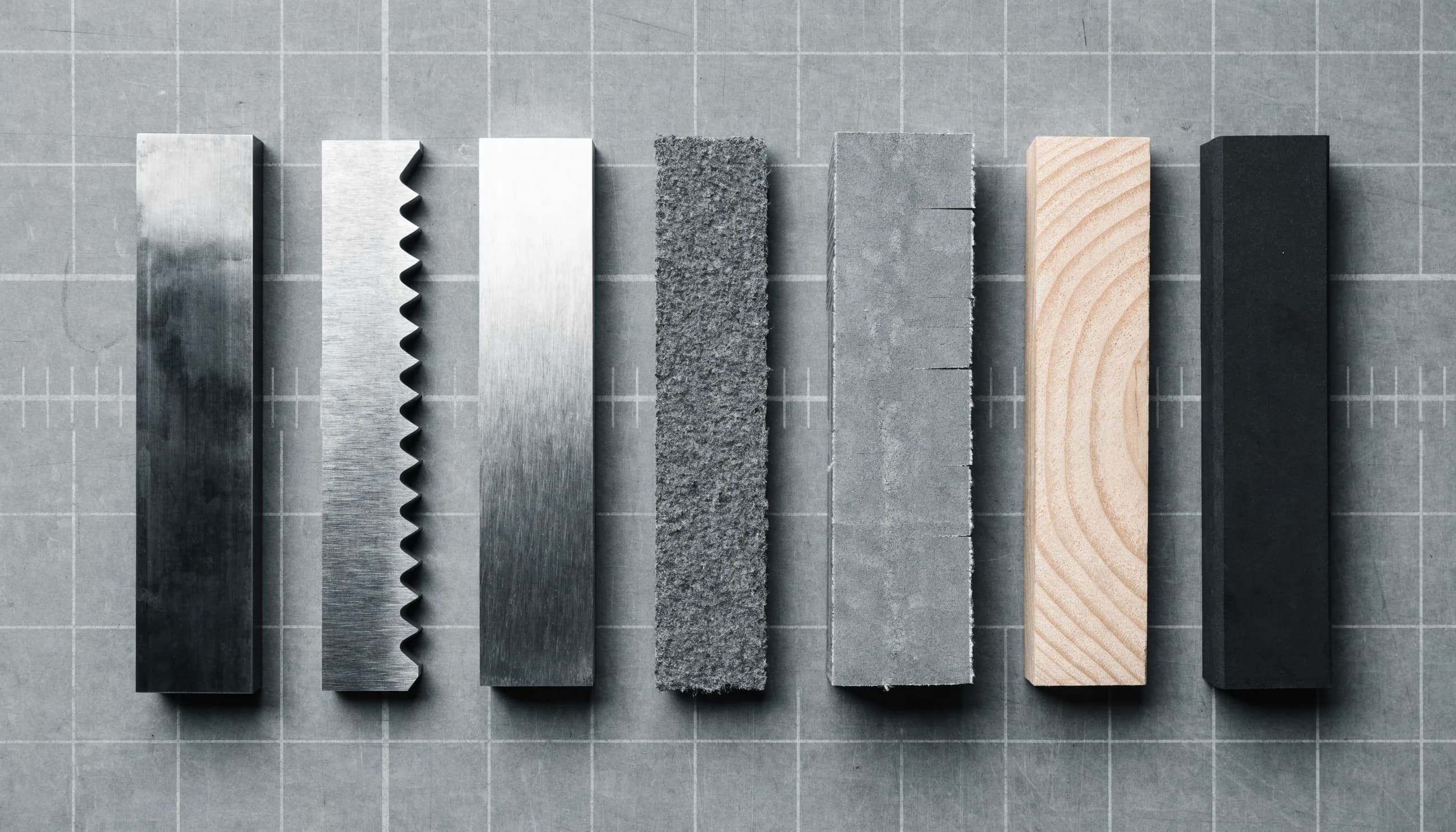
Seven materials, and what each one will not tolerate.
Every item in the catalog is built from one of these. The useful part of knowing which is not the romance of it — it is knowing what can be washed, what a degreaser will do to it, and which one thing will ruin it outright. All of that is below, per material.
Carbon Tool Steel
High-carbon steel hardened to roughly 60 HRC and left uncoated. It takes a far finer edge than stainless and holds it longer in plastic, and it will spot with rust if it is put away damp. That trade is deliberate: an edge you can strop back is worth more at this scale than one that never marks.
1 item in this material — Marden Sprue Nippers.
- Water
- Wipe it off and dry it the same session
- Degreaser
- Yes, then dry — it is uncoated steel
- Storage
- Dry, oiled lightly, not touching other steel
- What destroys it
- One cut through metal. It chips the bevel and it cannot be reground
Cut File Steel
Hardened carbon steel with the teeth cut rather than milled, which is what gives a needle file a clean shear instead of a scraped surface. Cut number is stated on every file. Teeth are brittle by design; a file used as a lever snaps at the tang.
1 item in this material — Needle File Set, Cut 2.
- Water
- Dry it immediately; these will spot
- Degreaser
- Yes on the tang, brush the teeth instead
- Storage
- Apart from each other — teeth chip teeth
- What destroys it
- Being used as a lever, and being spun in a rotary tool
Stainless Steel
Non-magnetic austenitic stainless used for tweezers, rules and caliper jaws. It will not spot, it will not pick up a magnetised part, and it is softer than tool steel — a stainless tweezer point bends before it breaks, which is the behaviour you want when you drop one.
5 items in this material — Reverse-Action Tweezers, Fine-Point Tweezers, Digital Caliper, 150 mm, Scale Rule, 150 mm, Spring Dividers.
- Water
- Yes
- Degreaser
- Yes
- Storage
- Points down, in a tray or a roll
- What destroys it
- One drop onto a hard floor. A bent point never meets square again
Abrasive Film
Graded aluminium oxide on a polyester backing rather than on paper. The backing does not soften or tear when wet, so the same sheet works dry on plastic and wet on filled surfaces, and the grade stays honest to the end of the sheet instead of wearing down to something finer.
3 items in this material — Abrasive Film, Graded Set, Polishing Film Set, Finishing Kit.
- Water
- Yes — it is made to be used wet
- Degreaser
- No, and no need
- Storage
- Flat and dry, not stacked damp
- What destroys it
- Heat, and a powered pad. The backing softens and releases grain
Self-Healing PVC
A three-layer mat with a soft core between two harder skins. A blade parts the core, which closes behind it, so the surface stays flat instead of collecting the tracks of every previous cut. It heals cuts, not heat or gouges — the limit is stated on the product page.
2 items in this material — Cutting Mat, A3, Bench Starter Kit.
- Water
- A damp cloth only
- Degreaser
- Never — solvent softens the top skin permanently
- Storage
- Flat, out of sun, never rolled
- What destroys it
- Anything hot set down on it. Heat gouges do not heal
Steamed Beech
Close-grained European beech, steamed and turned, used for file handles and sanding blocks. It is dense enough to take a ferrule without splitting and light enough not to unbalance a small tool. Left unlacquered so it takes on the shape of a grip rather than sliding in one.
1 item in this material — Beech File Handles.
- Water
- Keep it dry; beech moves with humidity
- Degreaser
- No
- Storage
- Dry, unfinished, ferrule end up
- What destroys it
- Driving a file tang in with a hammer. It splits at the bore
Engineering Polymer
Polypropylene, ABS and glass-filled nylon used where a part has to flex without taking a set, or hinge a few thousand times without whitening: tray lids, sanding stick cores, jaw guards and clamp bodies. It is chosen per part rather than bought as one plastic, and each product page names which one it is.
4 items in this material — Sanding Sticks, Painting Handles, Spring Clamps, Sorting Tray.
- Water
- Cool water only
- Degreaser
- No — it swells the clip sleeves
- Storage
- Closed, not clipped over an edge
- What destroys it
- Heat, and storing a spring clamp fully open until it takes a set
The one that catches people out
Never cut metal with a single-edge nipper. Not brass wire, not a photo-etch fret, not the steel axle that came in the box, not once “just to see”. The bevel is ground thin enough to close nearly flush, which is the entire reason it shears plastic cleanly instead of crushing it, and that same thinness means one cut through metal chips it. A chipped bevel cannot be reground at this size, so the tool is finished — it still cuts, but it will never leave a face you can use unsanded again. It is the single most common way a good cutter is destroyed, it happens to almost everyone once, and it is why the caution sits on the product page as well as here. If you remember one thing from this page, that is the one.
The expected range and the wear check for each tool are on the service life page and in the specification on every product page. Questions: hello@axonmodelco.com.